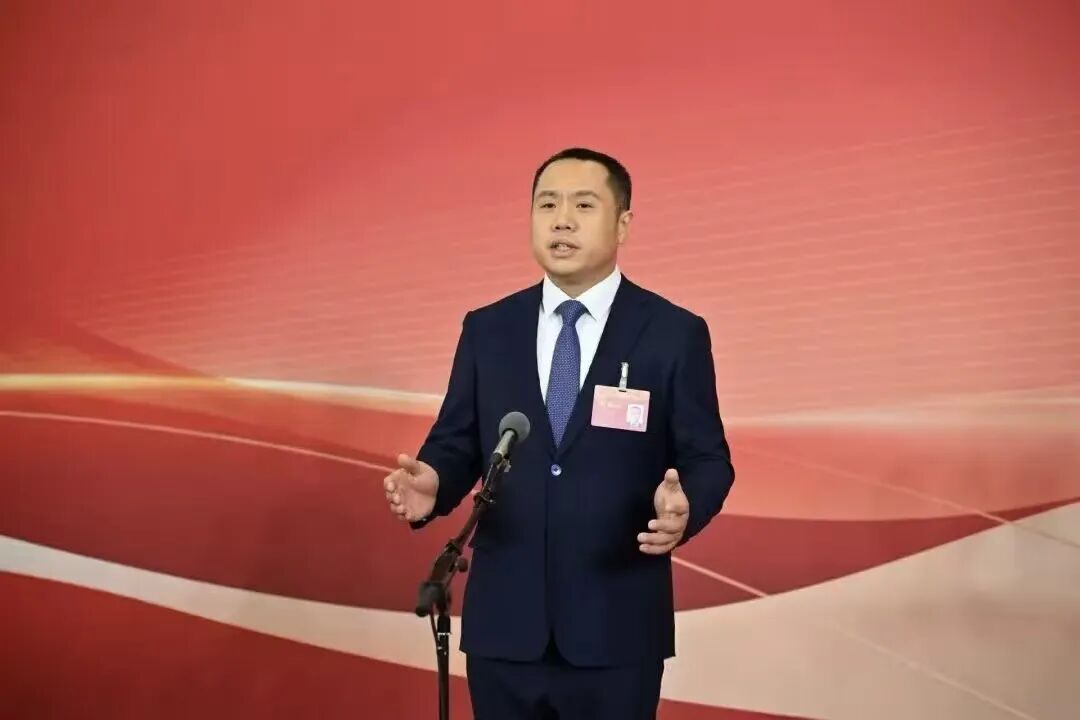
On January 26, at the "Deputy Passage" of the 14th Provincial People's Congress Fourth Session, Han Hong'an, deputy to the Congress and Chairman of Weihua Group, discussed the practical approaches and reflections on promoting high-quality development in the manufacturing sector and empowering the real economy, in line with the province's requirements for building a manufacturing powerhouse and a digital powerhouse.
When it comes to manufacturing, people often think of roaring machines, but today's production workshops have achieved quiet breakthroughs. Han Hong'an gave an example: "In the new energy vehicle factory we collaborated with, there is no noisy equipment operation throughout the workshop. Cranes autonomously handle and transport materials, with the entire process from raw materials to finished products requiring no manual intervention. The once 'big and bulky' machines have evolved into 'thinking, intelligent' transport robots."
Han Hong'an stated that for the manufacturing industry to truly strengthen, it must not rely solely on scale but also advance toward high-end, green, and intelligent development. "Innovation is a mandatory question," he pointed out. In the crane industry, anti-sway technology for lifting devices is a critical technical bottleneck. In the past, large cranes could experience an oscillation amplitude of up to 80 centimeters when stopping. Today, Weihua Group has developed the world's first anti-sway technology, precisely controlling the oscillation amplitude within 2 millimeters, achieving fast, stable, and accurate safe and efficient operations.
The company invests over 5% of its annual sales revenue in R&D, establishing a multi-tiered talent system ranging from academician experts to young engineers. It holds more than 1,800 authorized patents and 33 national and provincial-level R&D platforms, laying a solid foundation for innovation, said Han Hong'an.
Making green the foundation of development is key to achieving sustainable growth. Addressing the issues of bulkiness and high energy consumption in traditional cranes, Weihua Group successfully introduced a new generation of low-carbon cranes by employing high-strength steel, optimizing the overall structure, and streamlining the transmission system. This has led to a significant reduction of 15% to 30% in the crane's self-weight, height, and comprehensive energy consumption. The product has consistently held the title of annual sales champion for multiple years, with cumulative orders exceeding 4 billion yuan, achieving a harmonious balance between green development and economic benefits.
Currently, industrial digitalization has become a crucial direction for the transformation and upgrading of crane manufacturing. Almost every crane is "tailor-made" according to customers' diverse needs. In the past, designing a gantry crane required three weeks just to adjust the lifting speed. After over a decade of research, WeiHua Group independently developed a digital design platform, which will mature and be implemented by the end of 2025. Now, designing a crane takes only two hours, enhancing market responsiveness while optimizing the customer customization experience.
To achieve high-quality development in the manufacturing sector, it is essential to implement more "core" innovative technologies. Han Hong'an proposed the creation of a "private enterprise transformation empowerment platform" to connect university research, incentivize corporate innovation, remove bottlenecks in technology transfer, and help private enterprises transform advanced technologies into new productive forces.


